
Economic Calendar API for Official Release Dates
CleanScrape · @cleanscrape
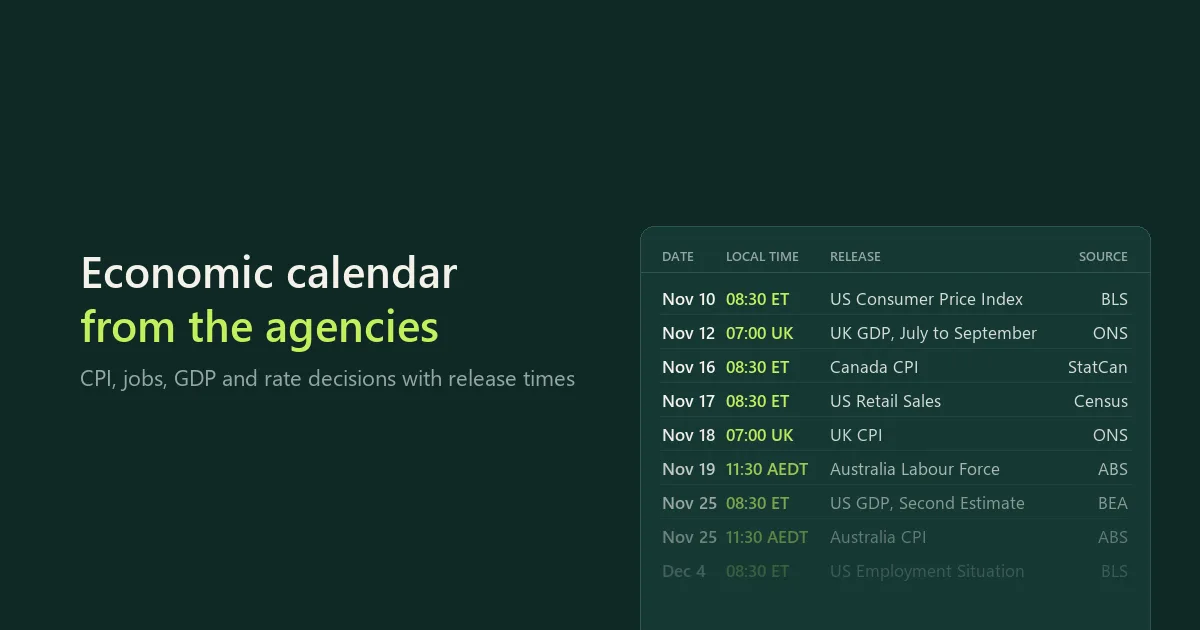
Release dates and times for CPI, jobs, GDP and central bank decisions in five economies, straight from the official agencies.
About
An economic calendar built only from official sources: release dates and times for CPI, jobs, GDP, retail sales, PCE and central bank rate decisions in the United States, the euro area, the United Kingdom, Canada and Australia. Pick countries and dates, export the calendar as CSV, Excel or JSON, or run it on a schedule to get only new, moved and released events. No login or API key.
Every date comes from the agency that publishes the number: BLS, BEA, Census Bureau, Federal Reserve, Eurostat, ECB, ONS, Statistics Canada, Bank of Canada, ABS and RBA. Times are in UTC and local time. No forecasts: consensus forecasts are compiled privately by calendar sites and are not included. Calendar coverage is broader than value coverage, and this is not a low-latency trading feed.
Start with a small run
- Choose United States, or another economy, under Countries.
- Choose Next 7 days and start the run. The other settings can stay as they are.
- Open the run's dataset for the events and download it as CSV, Excel or JSON. Coverage notes per source are in the
SOURCESrecord of the run's key-value store.
No source-site account, API key, cookie or proxy is needed.
Examples
US events for the coming week:
{
  "countries": ["US"],
  "dateRange": "next7"
}
High-impact releases across all five economies:
{
  "countries": ["US", "EA", "UK", "CA", "AU"],
  "dateRange": "next30",
  "minimumImpact": "high"
}
Past UK inflation releases with their values:
{
  "countries": ["UK"],
  "dateRange": "pastYear",
  "categories": ["inflation"],
  "includeValues": true
}
A daily watch of central bank rate decisions:
{
  "countries": ["US", "EA", "CA", "AU"],
  "dateRange": "next30",
  "categories": ["rates"],
  "watchName": "rate-decisions",
  "onlyChanges": true
}
The first watch run returns the matching events and saves them as the starting point. Run it again with the same name and filters (for example on a daily schedule) to get only new, moved, cancelled and released events. Use a new watch name if you change the countries or filters.
Coverage
| Economy | Calendar sources |
|---|---|
| United States | BLS, BEA, Census Bureau, Federal Reserve, DOL weekly claims and EIA weekly petroleum |
| Euro area | Eurostat euro-indicators and ECB monetary policy meetings |
| United Kingdom | Office for National Statistics |
| Canada | Statistics Canada and Bank of Canada rate announcements |
| Australia | ABS and RBA policy board meetings |
Fed Chair and Governor speeches and testimony are optional. Bank of England dates, consensus forecasts, private PMI values and nowcasts are not included.
How far back and ahead each agency lists releases (measured October 2026):
| Source | Past | Ahead |
|---|---|---|
| BLS | From January 2025 | To the end of the year (next year's schedule appears in December) |
| BEA, Census Bureau | From January 2025 | About 14 months |
| Federal Reserve | FOMC decisions from 2021; speeches and other events from 2017 | FOMC next year; other events this year |
| DOL weekly claims, EIA petroleum | Any date | To the end of the year |
| Eurostat | The past year | About 12 months |
| ECB | Decisions from 1999 | About 2 years |
| ONS | The past year | About 12 months |
| Statistics Canada | From 2012 (key indicators) | About 5 months |
| Bank of Canada, RBA | This year | About 14 months |
| ABS | About the latest 250 releases (back to late April 2026) | About 5 months |
Each run's SOURCES record shows the dates each source covered and any gap.
DOL and EIA dates follow published weekly schedules and holiday exceptions. Regular weekly entries are provisional. ECB rate decisions carry the ECB's standard announcement time, 14:15 CET, and Bank of Canada rate announcements its published time, 09:45 ET; both are marked standard. RBA board meetings are date-only: the RBA calendar gives no announcement time. Eurostat euro indicators are date-only because Eurostat's calendar does not give a time.
Reading the output
| Field | Meaning |
|---|---|
name | Agency's release or meeting name |
eventDate | Date in the agency's local time zone |
scheduledAt | Exact time where available; otherwise blank |
timeStatus | confirmed (the agency's calendar gives the time), standard (the institution's published standard time), provisional or date_only |
impact | CleanScrape's classification, not a prediction of market movement |
status | Scheduled, released, moved or cancelled, based on source evidence |
actual | A supported first-release figure, not a later revision |
latestValue | Current series value for that reference period; it may be revised |
unit | Percentage or index base used by the figure |
period | Month, quarter or other period covered |
releaseUrl | Link to check the release or calendar |
Blank values are intentional, not zero. Many entries are schedule-only. Passing an announcement time does not by itself mark a release as published. Local times account for daylight-saving changes; date-only entries do not receive an invented midnight timestamp.
Values included
| Source | Measure | Treatment |
|---|---|---|
| BLS | All-items CPI annual change | First-published figure from a matched dated release; latest annual change calculated from CUUR0000SA0 and rounded to one decimal |
| ONS | All-items CPI annual change, D7G7/MM23 | Latest value for the exact month |
| Statistics Canada | All-items CPI annual change, vector 41690973 | Calculated from the official index (2002=100) and rounded to one decimal; matched the published headline for June to September 2026 |
| ABS | All-groups monthly CPI annual change, CPI 2.0.0 | Calculated from the official monthly index and rounded to one decimal; matched the published headline for January and May to July 2026 |
| Eurostat | Final HICP annual change, ECOICOP v2 | Official first-published series, not flash or revised values |
Other indicators, policy-rate figures and quarterly ABS CPI are schedule-only for now. latestValueAsOf is the retrieval time, not the original announcement time. valueNote explains each matched figure: whether it describes actual (first published) or latestValue (may be revised).
Watches and interrupted runs
Watches report new events, moved times, cancellations and changes to supported values; the change field says which (new, moved, cancelled, released, value_updated or updated). Only complete source reads update the watch. A disappearing entry is not treated as cancelled. When a source gives neither a stable identifier nor a reference period, a date change can appear as a new event instead of a move. Two runs of the same watch never run at once: the second ends at the start and says so.
If one agency is unavailable, the others still return data and SOURCES records the gap. If every requested source fails, the run ends with nothing collected and says which sources failed.
Progress is saved as the run goes. Restart an interrupted run without changing its input to continue. Start a new run for a fresh snapshot.
Run report
SUMMARY in the run's key-value store gives the run's status, the number of events, the countries checked and one report per source. SOURCES lists each source with the dates it covered, its row count and any error, for people and for automation.
Pricing
$19 a month to rent it, after a 3-day free trial. Cancel at any time; access runs to the end of the month you paid for.
Runs use compute, paid from your Bytewells credit at Bytewells' rates, separately from the rental. No proxy is used. In tests on Bytewells, one country for a week used $0.0005 of credit, all five economies for 30 days $0.0007, and a year of UK inflation releases $0.0008.
There is no charge per event, so all five economies, past years and daily watches cost the same rental.
Sources and reuse
Each event and source row includes attribution and an official link. Original data are available directly from the agencies.
- BLS: public-domain agency data; BLS cannot vouch for analyses after retrieval. Reuse policy.
- BEA: source attribution. Reuse policy.
- Census Bureau: source attribution for government-produced statistics.
- Federal Reserve: source attribution, no endorsement. Disclaimer.
- Department of Labor: source attribution. Copyright.
- EIA: source and access date. Reuse policy.
- Eurostat: source attribution; formatting adapted by CleanScrape. Copyright.
- ECB: Original data available free of charge from the ECB. Terms.
- ONS: Open Government Licence v3.0. Terms.
- Statistics Canada: adapted from its release calendar and supported tables. This does not constitute an endorsement by Statistics Canada of this product. Open licence.
- Bank of Canada: source attribution and adapted formatting. Terms.
- ABS: CC BY 4.0, formatting adapted by CleanScrape. Copyright.
- RBA: Original cash-rate data available free of charge from the RBA. Copyright and data conditions.
Use it from the API
The Actor runs through the Bytewells API, which works with Apify's API clients: point the client's base URL at Bytewells (see Bytewells docs) and call cleanscrape/economic-calendar-api with the input JSON from the examples above. The events are in the run's default dataset.
Common questions
Where does the data come from?
From the agencies that publish the numbers: their release calendars, calendar files and public data APIs. Free calendar websites copy the same agency schedules and type the values in by hand; this Actor reads them directly and links to the official release.
Does it include consensus forecasts?
No. Consensus forecasts are collected privately by data vendors and calendar sites, and no official source publishes them. The Actor gives the official schedule, the first-published value where it can be read from the release itself, and the latest value of the series.
How accurate are the times?
They come from the agencies' own calendars and are converted to UTC with daylight-saving changes taken into account (the UK and the US change clocks a week apart). In October 2026 all 27 US releases for November and December matched an independent release calendar to the minute.
Can I export to Excel or Google Sheets?
Yes. Download the run's dataset as Excel, CSV or JSON, or read it from the API into a sheet.
What does a run cost on top of the rental?
Only the compute it uses, from your Bytewells credit. Test runs used $0.0005 to $0.0008 each.
Is it legal to use the data?
The data is published by government agencies and central banks for public use; each row carries the source's attribution and licence link. Some sources ask you to mention that the original data is available free of charge from them (ECB, RBA). This is not legal advice.
Support
CleanScrape maintains this Actor and fixes it when an agency changes its calendar. If something looks wrong, email [email protected] with the run ID, the agency and the release you expected. Never include API tokens or private data.
Disclaimer
This Actor is an independent tool developed by CleanScrape. It is not affiliated with or endorsed by the source agencies or central banks. Source names identify coverage, not sponsorship. Schedules can change. This is not investment advice.
More tools from CleanScrape
- Google Trends Scraper API for Interest Over Time: search interest over time, by region, related queries and trending searches
- Career Page Jobs Scraper for Workday, Greenhouse and Lever: open jobs from company career pages, with salaries and new or closed jobs
- Whatnot Scraper for Listings and Live Shows: Whatnot listings with prices and sellers, live shows, and alerts for new listings
- Whatnot Seller Tracker for Top Sellers and Sales: top Whatnot sellers per category, items sold, sales per day and followers over time
- Google Flights Scraper and Fare Tracker: flight prices, airlines, stops and times for your routes and dates, with only new or cheaper flights
- App Store and Google Play Reviews Scraper: reviews from both app stores in one table, with daily alerts for new low ratings
- Shopify Product Reviews Scraper for Judge.me and Okendo: Judge.me and Okendo reviews from Shopify product, collection or store links
- Flashscore Tennis Scraper for Tennis Matches and Stats: tennis results, statistics, point-by-point, form and head-to-head
- ATP and WTA Tennis Rankings Scraper: current ATP and WTA singles, doubles and race rankings with points and movement
- Google News Scraper and RSS Feed Reader: Google News searches, sections and publisher feeds, with only new articles on a schedule
- Google Hotels Scraper for Google Travel Hotel Prices: hotel prices and every booking offer for your dates, adults and currency
- Telegram Channel Messages Scraper with Comments: public Telegram channel posts with views, reactions and comments, and only new posts on a schedule
FAQ
- Where does the data come from?
- From the agencies that publish the numbers: BLS, BEA, Census Bureau, Federal Reserve, Eurostat, ECB, ONS, Statistics Canada, Bank of Canada, ABS and RBA. Each row links to the official release or calendar.
- Does it include consensus forecasts?
- No. Consensus forecasts are compiled privately by data vendors and no official source publishes them. You get the official schedule, the first-published value where it can be read from the release, and the latest value of the series.
- How do I get only new or moved events?
- Give the run a watch name, turn on Only new or changed events and schedule it. The first run saves the matching events; later runs return only new, moved, cancelled and released ones.
- What does a run cost on top of the rental?
- Only the compute it uses, from your Bytewells credit. No proxy is used. Test runs used $0.0005 to $0.0008 each.
- Is this investment advice?
- No. It is a calendar of official release dates and published figures. Schedules can change, and this is not a low-latency trading feed.
Input
Preview of the input form. Rent the Actor to fill it in and start runs from the console.
Fields
countriesChoose one or more economies.
dateRangeWhich release dates to include. Choose dates uses Start date and End date below (up to one year).
startDateYour own first day, used with Dates on Choose dates or left on Next 7 days.
endDateInclusive. Up to one year per run.
Usually no changes needed.
minimumImpactCleanScrape classification, not a forecast of market movement.
categoriesLeave empty for all categories.
includeSpeechesChair and Governor appearances listed by the Federal Reserve.
includeValuesAdds verified figures where supported. Many releases are schedule-only; see README for coverage.
watchNameOptional. Reuse a name such as weekly-planning to compare runs with the same filters.
onlyChangesRequires a watch name. The first run creates the baseline and returns its matching events.
API
Bytewells speaks the Apify API. Existing integrations keep working: point apify-client at https://bytewells.com/api and use your Bytewells API token (Console → Settings → API access). The Actor ID is cleanscrape/economic-calendar-api (or cleanscrape~economic-calendar-api in URLs).
JavaScript · apify-client
import { ApifyClient } from 'apify-client';

const client = new ApifyClient({
  token: process.env.BYTEWELLS_TOKEN,
  baseUrl: 'https://bytewells.com/api',
});

const input = {
  "countries": [
    "US"
  ],
  "dateRange": "next7",
  "minimumImpact": "low",
  "includeSpeeches": false,
  "includeValues": true,
  "onlyChanges": false
};

const run = await client.actor('cleanscrape/economic-calendar-api').call(input);
const { items } = await client.dataset(run.defaultDatasetId).listItems();
console.log(items);
Python · apify-client
import os
from apify_client import ApifyClient

client = ApifyClient(os.environ["BYTEWELLS_TOKEN"], api_url="https://bytewells.com/api")

run_input = {
    "countries": [
        "US"
    ],
    "dateRange": "next7",
    "minimumImpact": "low",
    "includeSpeeches": False,
    "includeValues": True,
    "onlyChanges": False
}

run = client.actor("cleanscrape/economic-calendar-api").call(run_input=run_input)
items = client.dataset(run["defaultDatasetId"]).list_items().items
print(items)
HTTP · curl
curl -X POST "https://bytewells.com/api/v2/acts/cleanscrape~economic-calendar-api/runs" \
  -H "Authorization: Bearer $BYTEWELLS_TOKEN" \
  -H "Content-Type: application/json" \
  -d '{"countries":["US"],"dateRange":"next7","minimumImpact":"low","includeSpeeches":false,"includeValues":true,"onlyChanges":false}'
Runs are billed as compute from your credit balance. Paid Actors need an active rental or trial; otherwise the API answers 402 rental-required.
Related
More Actors from the same publisher.

App Store and Google Play Reviews Scraper
CleanScrape · @cleanscrape
App Store and Google Play reviews in one table, with ratings, text, dates and app versions, plus daily alerts for new low ratings.
Developer toolsMarketingAutomation$12/mo7-day free trial
ATP and WTA Tennis Rankings Scraper
CleanScrape · @cleanscrape
Current ATP and WTA rankings from Flashscore: singles, doubles and the races, with points, movement and country, by player or country.
OtherDeveloper toolsAutomation$12/mo7-day free trial
Flashscore Tennis Scraper for Tennis Matches and Stats
CleanScrape · @cleanscrape
Tennis results and match statistics from Flashscore by tournament, player or day, with point-by-point, form and head-to-head.
AutomationDeveloper toolsAI$19/mo3-day free trial
Google Flights Scraper and Fare Tracker
CleanScrape · @cleanscrape
Scrape Google Flights fares by route and date: prices, airlines, stops, layovers, local times and price level. Track only new or cheaper flights.
AIAutomationDeveloper tools$29/mo3-day free trial
Career Page Jobs Scraper for Workday, Greenhouse and Lever
CleanScrape · @cleanscrape
Scrape jobs from company career pages on Workday, Greenhouse, Lever, Ashby and four more systems, with salaries and new or closed jobs.
AIAutomationJobs$29/mo3-day free trial
Google Hotels Scraper for Google Travel Hotel Prices
CleanScrape · @cleanscrape
Hotel prices from Google Hotels for your dates, adults and currency, with every organic booking-site offer for each hotel.
TravelAutomationDeveloper tools$15/mo7-day free trial